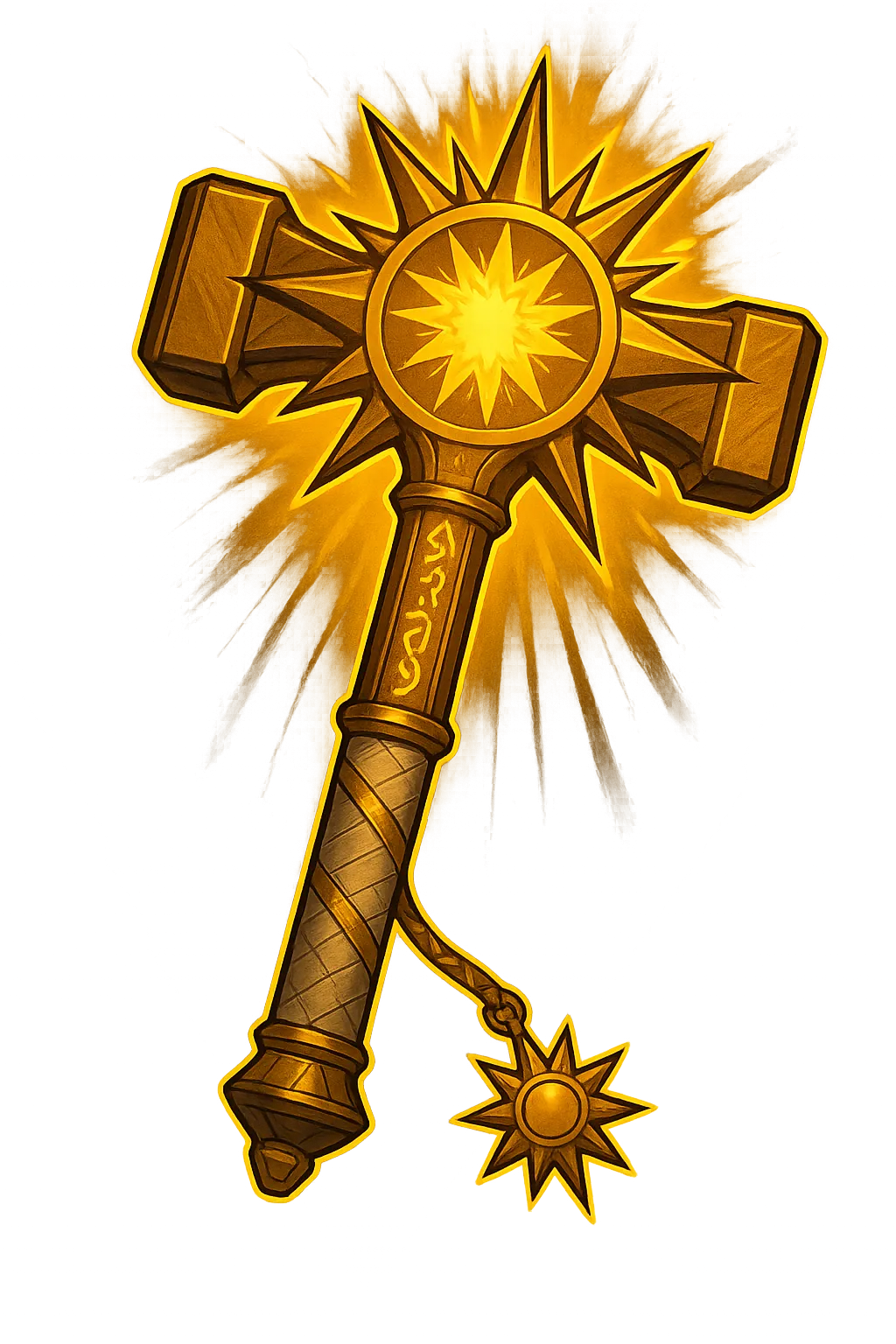
The Hammer of Elandria is one of the last surviving relics forged during the First War, when the gods still walked among mortals to stand against Taelkor. As a weapon of divine light and moral clarity, it bears the unmistakable touch of Elandria’s hand.
The warhammer’s head resembles a radiant sunburst, sculpted from consecrated sunsteel that never tarnishes. Intricate, spiraling sigils written in the forgotten script of the Builders glow softly along its haft, resonating only for those who have passed the Trials of Light. The grip is wrapped in pale leather, embroidered with golden thread, and at its pommel hangs a small sunburst charm.
When raised, the Hammer emits a warm, steady glow that banishes shadow and deception. In battle, that glow intensifies into lances of searing radiance, burning with the resolve of its wielder. It is not merely a weapon, it is a verdict rendered in divine steel.
It is one of only three relics that remain from the First War: the Hammer of Elandria, the Ring of Silver Water, and the Crown of Judgement.
Attunement - The Trials of Light
Attuning to the hammer must be done at The First Shrine in Solaris, the capital city of the Kingdom of Solara. It is the most holy site of the Church of Elandria.
As Dravencoles reaches the inner sanctum, he should place the Warhammer upon the Altar of Light. The chamber seals. Radiant sigils encircle the altar, and three luminous avatars of Elandria’s justice manifest, each presenting a moral dilemma.
Trial 1: The Balance of Justice – Empathy vs Retribution
A murderer kneels before you, unarmed. He has shown no remorse, but you can feel his pain. Do you strike him down, or spare him to find his own redemption?
- Empathy: Once per long rest, the Warhammer can cast Sanctuary.
- Retribution: Once per rest, after hitting a creature that has dealt damage to an ally, the Warhammer deals +4d6 radiant damage.
Trial 2: The Nature of Light – Confession vs Containment
A young paladin stands before you in the sanctum, hands trembling, eyes downcast. He speaks:
“I have thoughts… dark ones. Rage. Pride. Sometimes I wonder if I serve for the Light’s sake, or for my own glory.”
He kneels. “Should I confess this to the Order? They will cast me out, maybe worse. But if I hide it, I can keep serving. I can still do good.”
- Confess: When you use Divine Sense, you also learn if a creature within range is hiding a great guilt, secret, or moral conflict.
- Hide: Enemies have disadvantage when trying read your mind or emotions.
Trial 3: The Duty of Power – Leadership vs. Service
The Hall of Flame is quiet as morning light filters through stained glass, casting golden patterns across polished stone. High Marshal Aurent stands at the altar, removing his mantle, a cloak of radiant silk and sunsteel.
“Dravencoles,” he says, voice calm but worn, “I’m retiring. The world needs a steadier hand than mine. The council agrees it should be you.”
“You could lead the Order. Shape more than battles. Shape the future.”He holds out the mantle. But before you can answer, Lirielle steps through the hall’s archway, her robes travel-worn and streaked with ash.
“That’s real work,” she says. “But the kind we do? The kind no one sees? That still matters. People out there are waiting for someone to show up. Not with policy. With help.”
The mantle waits in Aurent’s hands. The Warhammer hums at your side.
Which will you choose, Leadership or Service?
- Service (Humility and Protection): Once per long rest, when an ally within 10 ft. drops to 0 HP, you can immediately move and take the damage instead.
- Leadership (Leadership and Authority): Once per long rest, issue a divine command without using a slot or concentration. The target must roll its saving throw with disadvantage.